OpenAI Codex Time to Fly: The $1,000 Credit Game Developers Should Notice
OpenAI's Time to Fly turns a Codex showcase into a live developer puzzle, with a level-five victory screen that can show a $1,000 token reward.
Key takeaways
- OpenAI lists Time to Fly as an official showcase project authored by OpenAI, with a live game at codextimetofly.com (OpenAI Developers).
- The game is described as a five-level cosmic logic puzzle built in Codex with GPT-5.5 and GPT Image 2 (OpenAI Developers).
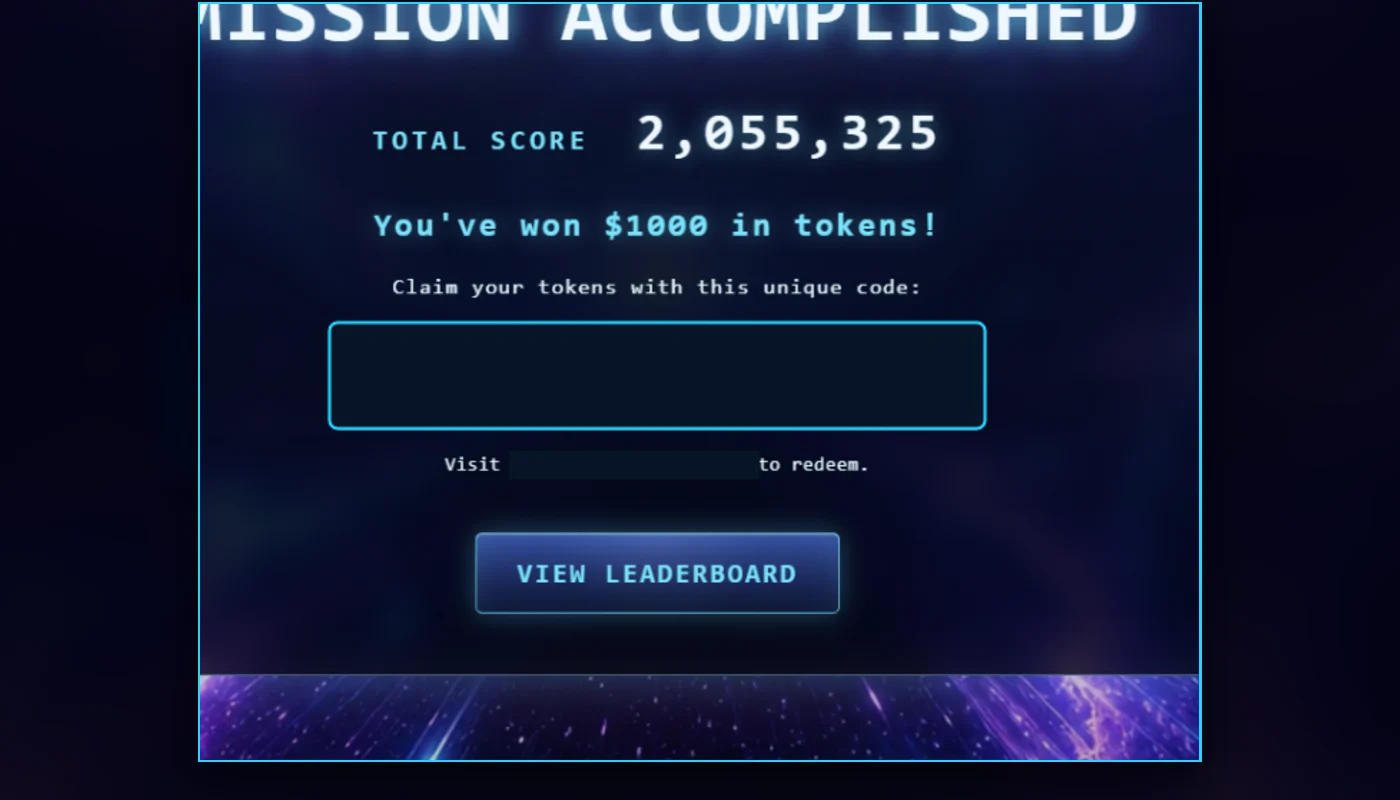
- A reviewed completion screenshot shows "Mission Accomplished" and "You've won $1000 in tokens!" after the final level, followed by a private redemption code.
- The practical reader takeaway is simple: treat the offer as limited and first-come, and never post a raw redemption code publicly.
OpenAI Codex Time to Fly is not just another developer demo. It is a small but revealing example of how AI developer products are being marketed in 2026: make the demo playable, make the build process inspectable, and make the reward immediately useful for developers who want to try the tool.
The official OpenAI showcase page describes Time to Fly as a cosmic logic puzzle. Players position planets along fixed orbits, set a rocket's launch angle, and use gravity to bend the rocket toward a distant galaxy across five increasingly difficult levels (OpenAI Developers). That makes it a useful Codex proof point even before the reward layer appears.
The reward layer is what makes the topic trend-worthy. A completed run screen reviewed by TrendsWhat shows a total score, the line "You've won $1000 in tokens!", and a unique redemption code. The code itself is private and should be treated like a credential. The article and thumbnail intentionally do not publish it.
Why is OpenAI Codex Time to Fly getting attention?
OpenAI Codex Time to Fly is getting attention because it turns a product showcase into a challenge that developers can actually finish.
Most AI demos ask the reader to watch. This one asks the reader to play. The official showcase says the game was built in Codex with GPT-5.5 and GPT Image 2, then documents the initial prompt, mechanics, iteration notes, scoring, leaderboard work, optimization, and anti-cheat hardening (OpenAI Developers). For developers, that combination matters more than a polished screenshot.
The game itself is also tightly aligned with the Codex pitch. It is visual, interactive, stateful, and testable. The final version includes scoring and leaderboard behavior, and OpenAI's notes say the project was hardened with server-verified runs and anti-cheat protections (OpenAI Developers). That is exactly the kind of workflow Codex is meant to demonstrate: not just writing code, but iterating toward a shippable app.
How the $1,000 credit screen changes the story
The $1,000 credit screen changes Time to Fly from a showcase into a developer acquisition event.
The reviewed completion screenshot shows a "Mission Accomplished" state after level five and a private redemption code tied to a $1,000 token reward. Because the code is unique, it should not be shared, screenshotted publicly, or copied into public articles. The safer way to describe the offer is that completed runs can surface a private reward screen, and that availability may be limited or first-come.
That distinction matters. The official showcase page verifies the project, live URL, game structure, and build stack. The reward screen verifies that at least one completed run reached a $1,000 token claim state. It does not prove that every future player will receive a still-available code indefinitely. Promotions can expire, allocations can run out, and account eligibility can vary.
For readers, the action path is still clear: visit the official showcase, open the live game, clear all five levels, and follow the on-screen redemption flow if a code appears.
What developers can learn from the build
Time to Fly works because the demo is narrow enough to finish and rich enough to prove capability.
The initial prompt asks Codex to build a polished cosmic logic puzzle where players guide a rocket into a distant galaxy by positioning planets and using gravity. It specifies fixed orbits, no trajectory preview, no lives, immediate retry, and a level curve from one planet to five planets (OpenAI Developers). That is not vague "make a game" prompting. It is a compact product specification.
The iteration notes are the more important part. OpenAI says the project refined gravity gameplay, redesigned the level difficulty curve, introduced hazards with moons, improved controls and responsive layouts, added scoring and leaderboard behavior, reduced assets from roughly 33 MB to 2.8 MB, and added automated gameplay and leaderboard regression coverage (OpenAI Developers).
That list is a practical Codex lesson: a good agentic coding demo is not only about the first generation. The value shows up in the loops after generation - tuning mechanics, validating difficulty, polishing assets, reducing bundle size, and testing the system.
The right way to treat the reward
The right way to treat the reward is as a private promotional code, not public content.
If a completion screen exposes a redemption code, the code should be redeemed through the link shown in the game flow and kept out of public screenshots. Anyone publishing about the promotion should mask the code area. That is why this article's proposed thumbnail uses the real victory-screen context but redacts the unique code.
There is also a product lesson here. A $1,000 token reward is large enough to move a curious developer from "interesting demo" to "I should try this now." It lowers the cost of experimenting with Codex, especially for users who want to test longer coding sessions, visual iteration, or app-building workflows.
FAQ
What is OpenAI Codex Time to Fly?
Time to Fly is an OpenAI showcase game built in Codex with GPT-5.5 and GPT Image 2. Players solve five gravity puzzle levels by positioning planets and launching a rocket toward a galaxy (OpenAI Developers).
How do players reach the $1,000 credit screen?
The reviewed winner screenshot shows the reward screen after the final mission is completed. Players should treat the reward as limited, first-come, and subject to the live redemption flow.
Is the redemption code public?
No. The redemption code is private. It should be masked in screenshots and should not appear in public articles, social posts, or thumbnails.
Why does this matter for developers?
It shows how OpenAI can use Codex demos as a full developer funnel: the app demonstrates Codex capability, the build notes explain the process, and the credit reward gives developers a reason to try the product immediately.
Sources
The public source is OpenAI's showcase page; the reward detail is based on a private completion screenshot reviewed for this draft.
- Time to Fly - OpenAI Developers, accessed June 4, 2026.
- Time to Fly live game - linked from the OpenAI Developers showcase page.
- Completed Time to Fly reward screen - private screenshot reviewed by TrendsWhat on June 4, 2026. The redemption code is intentionally withheld.